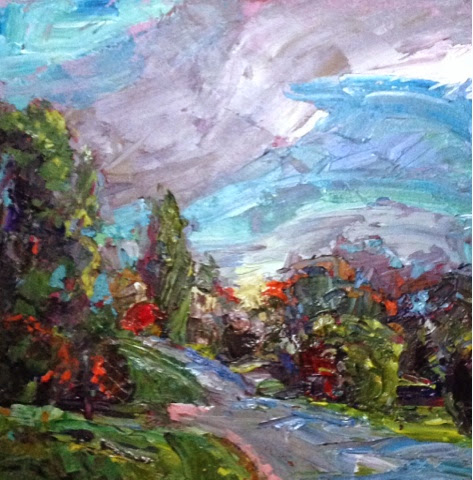
This afternoon I painted en plein air using acrylic paints. My intent was to abstract the scene to get a more patterned and design oriented composition.
If I had to do it over again I would have made a more comprehensive sketch. But the sky was in transition and I wanted to quickly record the movement of the high clouds before they changed. Plein air painting often includes the paradox of compromising process in order to get the best results.
I was surprised that painting outside with acrylics was as easy as it was. It was a nice day around 70°F and my paint remained wet on the palette throughout the entire painting process. I painted fast covering the entire 20″ x 20″ surface using palette knives.
Eventually every artist has to write an artist’s statement. I have an abstract show in a few weeks–the first for me in that genre–and the gallery requested a statement. I reviewed a lot of approaches. It’s an abstract show so I could be philosophical, even didactic. But I abandoned that approach as too inaccessible. I could intertwine my statement with my history. But that seemed too complex and irrelevant. I decided I needed a statement that got to the heart of why I paint abstracts yet be entertaining and perhaps even playful. After weeks of introspection I decided I paint abstracts to achieve a timeless frame of mind–a state where time stands still. The emotions of timelessness are then potentially transferred to the viewer as they contemplate the painting. I remembered a prose poem I wrote in my graphic novel Cypherentitled Moment in Time that plays with the the feeling that time is elastic and can be manipulated. I found a copy of the book and condensed the prose poem into a new version. I’m using it as my artist’s statement:
I paint to stop time.
To lengthen time I fill it with nothing. I empty the moment, let the edges shrink, until it becomes nothing.
To shrink time I fill it with everything.
To suspend time I layer color on texture—each layer frozen in time.
When viewed the paint is dissembled in reverse moments of layer over texture over color—and time stands still.
No doubt some will still find this too philosophical or even pretentious. But it has several advantages over many statements—it is short, it has a sense of fun, and most importantly, it is actually true. Whether everyone will have a time-altering experience when they observe my paintings is another matter. I did when I painted them. I still do as an observer.
Section of my painting with palette strokes and brush strokes.
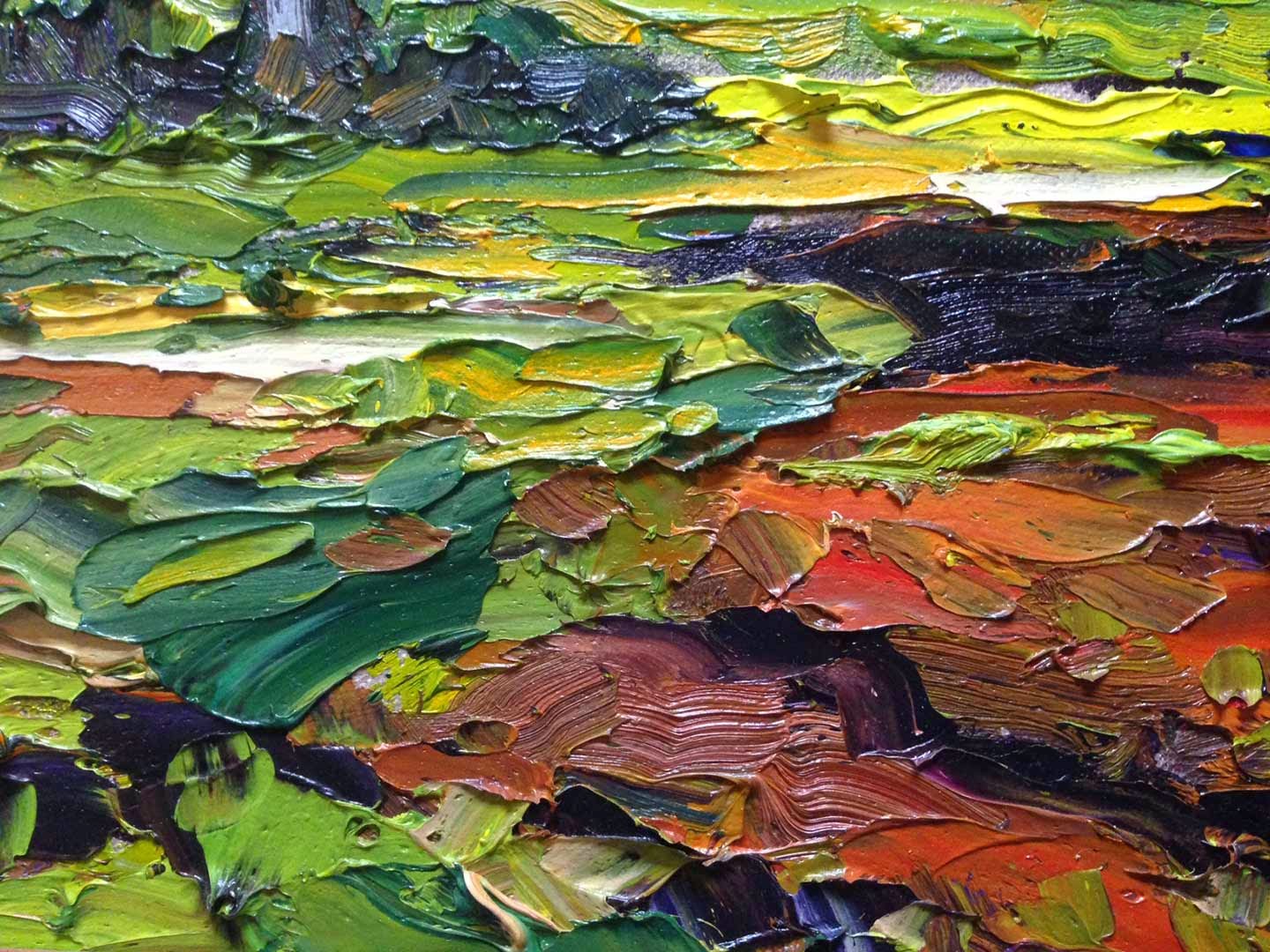
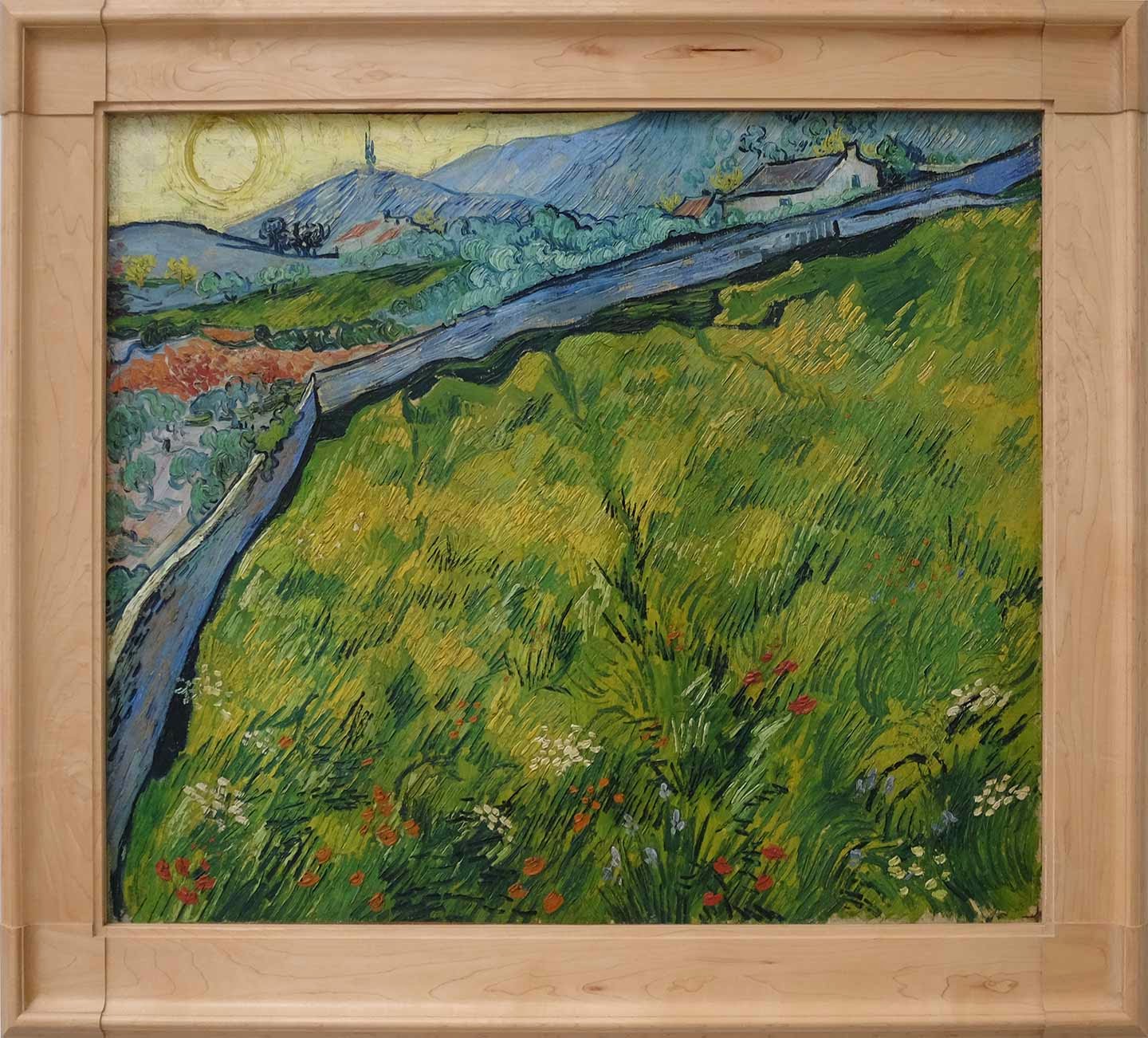
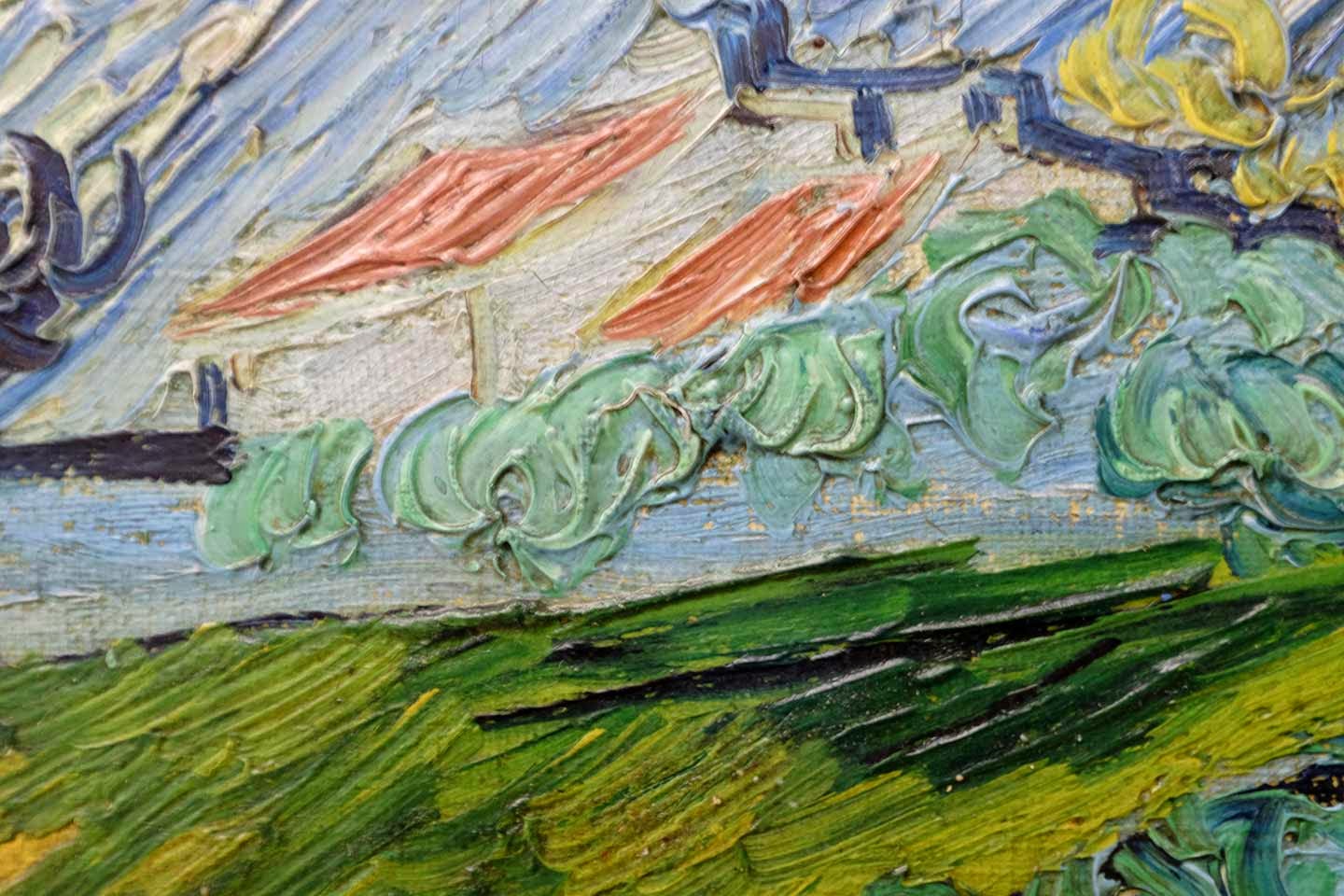
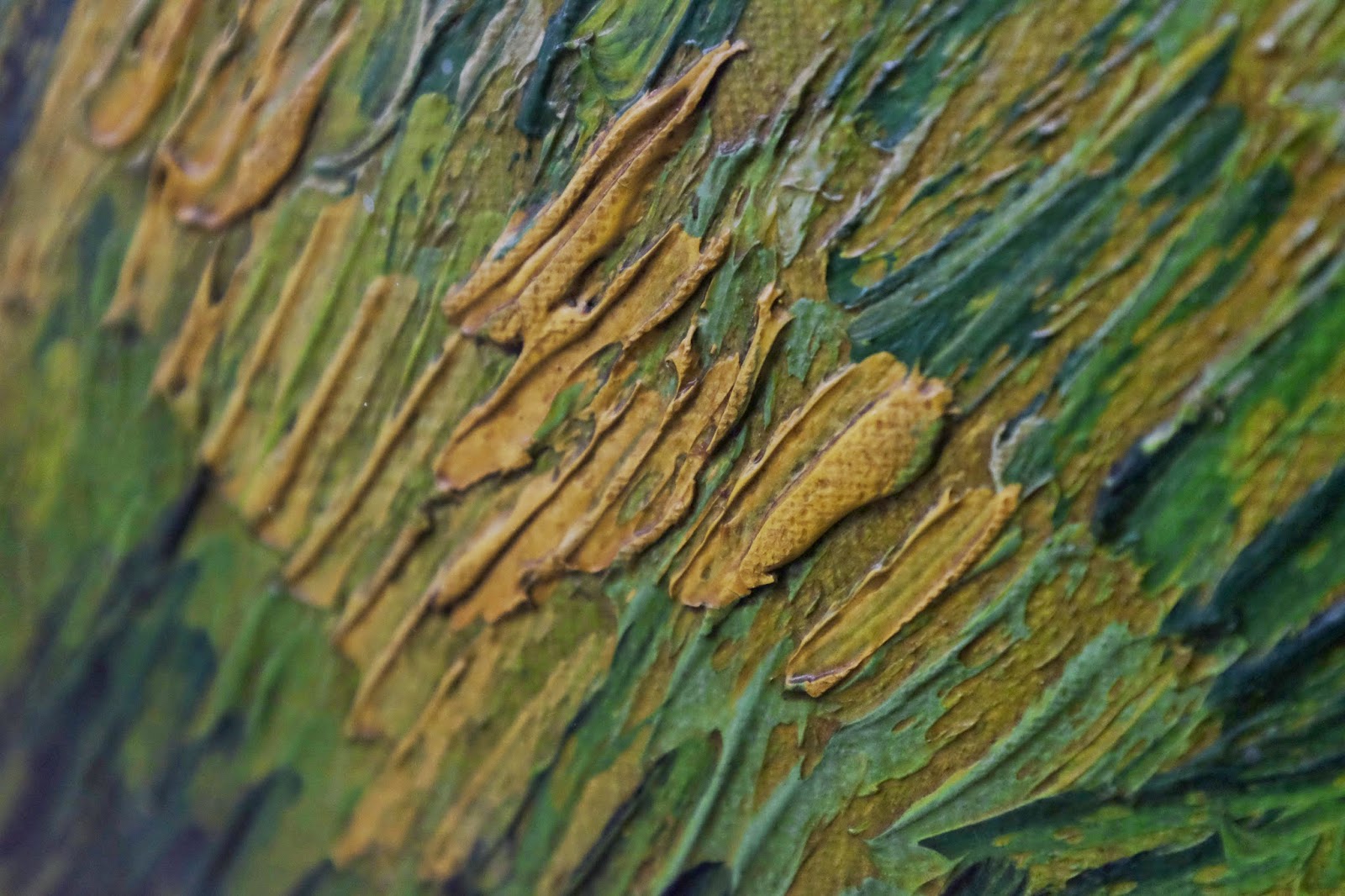
DIDVan Gogh load his brush? Most assume he didn’t–but used the standard technique of picking up paint directly from the palette (watch how to load a brush here). I suspect he used ample amounts of paint to more easily get broken color on his brush and onto his canvas (small piles of paint lead to cramped, tight painting with monochromatic strokes). Fellow painter Erik te Kamp went to the Kröller-MüllerMuseum in the Netherlands and took several close-up photos of Van Gogh’s work. Erik noted that the paintings are over 125 years old and some passages look a little transparent. Because Van Gogh never varnished his paintings you can see an accumulation of dirt in the paint strokes (learn how new methods improve varnishing for modern painters here). What follows is an analysis of Van Gogh’s technique. I start with a close-up of a recent painting of mine for contrast (since I know which strokes are brush or palette knife marks with absolute certainty). You can clearly see both palette knife and brush marks in my painting. The principal example of a palette knife mark is the dark green stroke in the southwest quadrant. The most visible brush strokes are the purple-brown marks in the center lower half. Clickimages twice to see a larger view and use the back arrow to return. The next image–courtesy of Eric te Kamp and the Kröller-Müller Museum–is a painting by Van Gogh entitled Green Field. (Incidentally, I love the maple frame. I compliment the museum on such an apropos presentation). The next image is a close-up of the distant horizon. We see two flecks of red representing the tiled roofs of distant houses. There is evidence of brush marks andpalette knife marks. Marks from the brush’s bristles can clearly be seen in the green section. The light bluish-green vegetation in front of the houses appears to be made with a narrow, flat-ended palette knife–most notably in the stroke just right of center. This was completely unexpected, but further close-ups suggest he used both brushes and palette knives. The following image–an extreme close-up of the strokes of grass–confirms the claim. Note the hard edges on the upper sides of the central yellow strokes.
In the following image—where you see dabs of color representing flowers —some dabs have brush marks and some don’t. This is an example of Van Gogh painting with paint rather than with the brush. Meaning that so much paint was on his brush that no bristle marks were impressed into the resulting strokes. There is controversy about whether Van Gogh was right or left handed. I guess from this painting that he was right handed. Van Gogh was a bold painter, and the grass strokes would have been less consistent if he were holding the brush in his left hand. This is also corroborated by several self-portraits of Van Gogh holding the palette in the right hand. Which would have been reversed since he would have been looking into a mirror to paint his portrait. It is possible that he used his left hand for palette knife work but I see no evidence of that. Portraits of Vincent also show that he used generous amounts of paint on his palette. Which is good practice if you want to have lots of broken color in your paintings. Many thanks to Erik te Kamp for the fascinating close-ups of Van Gogh’s work. He sent me more images, and I will analyze them in future blog entries. If anyone is close to a museum featuring paintings of J. M. W. Turner and would be willing to take similar photos, I would love to do a similar analysis of his work. Many thanks in advance for your help. Brad Teare–October 2014
This week I’m getting ready for for two shows–an abstract show that will be the largest exhibit of my work to date–and a one night landscape show that in the past has been the best show financially of the year (once I earned 25% of my income for that year in one night).
My studio is packed with paintings. As I look at them I realize what a varied career I’ve had. I’ve done illustration, woodcuts, comics,photorealist acrylics, and impressionist oils. I see elements of all styles in my current work. The abstract phase of my career came as a complete surprise and evolved out of experimentation with extremely thick oil paint on small canvases. I decided if I wanted to paint with that much texture I needed to shift to acrylics using a variety of texturing and thickening mediums.
There are common themes running through the two shows. Both concern themselves with texture–the abstracts are an extreme case of texture obsession. But color is important too. Both have lots of fields effects that maximize the perception of color.
I’m surprised how much I’ve learned with the abstracts has cross-pollinated into the landscapes. I have no intention of abandoning either style. I’ve made peace with the fact that although it would be economically more rewarding to focus on one genre I’m incapable of making a sound business decision.
So what is style? It is a fusion of everything visual you love with the technique you are physically capable of producing. Sometimes your gifts–or lack thereof–will trump your passions and radically modify your expression. Sometimes your discipline will triumph and you will be able to infuse a new method of expression into your creative gifts. If you are honest about the process a genuine mode of expression will emerge that will be 100% yours. It will be a treasure nothing can diminish. It will have its virtues yet be flawed–just like you. Above all it will be the expression of a unique mind.
All changes, even the most longed for, have their melancholy–for what we leave behind is a part of ourselves–we must die to one life before we enter another. –Anatole France Life is a series of transforming events. Move forward. Be open to new directions. Experiment. Synthesize. Brad Teare–November 2014
I’ve been drawing with Liquitex and Montana acrylic markers and have really enjoyed the expressive nature of the medium. I sketched directly onto a 24″ x 30″ canvas using an 11″ x 14″ oil study as reference. In the video below you see the entire process. I didn’t edit out a single frame as I thought it would be interesting to see how spontaneous an underpainting can be. The video is twelve minutes and I used the large 15mm nib.
I posted the video via Gbox–my favorite video venue–and it’s free. It is listed as Fund Raiser which means viewers can donate if they want. But please feel free to watch without charge. I hope you enjoy it. As always please post questions or comments below. The AccuView app mentioned in the video formats your photo reference into a wide array of formats and grids. It’s very cool and I use it all the time to transfer reference to canvas.
I recently made a magazine of my abstracts to promote my show at Alpine Art in February 2015. It was fairly easy using Blurb although I wasn’t able to use the InDesign plugin and had to upload a PDF via their site–which I would recommend as I wasted a lot of time trying to trouble shoot the plugin. I think the project was successful although I won’t really know until the hardcopy magazine is delivered. Preview it below and let me know what you think. UPDATE: The magazine came within a few days and it looks beautiful. Hats off to Blurb for such excellent production values. Brad Teare–November 2014
Below is a short video of two shows I had in November. One was a one-night landscape realist show at Zions Bank and the other a two month abstract show at Harmons in downtown Salt Lake City. It is an unconventional venue–it’s a grocery store–but the exhibit will be up for the Sundance Film Festival. Most Park City Galleries are closed during Sundance so art enthusiast have limited places to see art. There are several Sundance theater venues just a few blocks from the exhibit so I think it will get some great exposure. Many thanks to Linda Martin for encouraging me to try some unconventional venues. Many have asked how sales were at the shows. I sold one 16″ x 20″ at the Zions Bank show which was less than usual but unexpectedly sold a small abstract the night we were hanging the abstract show. It was unexpected because we hadn’t even gotten the painting on the wall before it sold. Many thanks, Paul! After the exhibit ends in Mid-February it will hang at Alpine Art for another month making for some great exposure. Many thanks to Susan and Alpine Art for making this extended show happen!
I look forward to our Google Hangout. See you then! Brad Teare–November 2014
I AM currently at the Harmons City Creek gallery open house. I’m sitting in front of a wall of paintings with a bunch of my newly minted magazines waiting for art buyers to come by. A few people have stopped to look but I’ve been unable to come up with any salient comments. It seems I’ve been in this position dozens of times—at a gallery opening where all intelligent comments evaporate from my mind.
So what should I say to prospective buyers? The first thing that came to mind is to simply introduce myself saying “hello, I’m the artist. Do you have any questions?” It seems a little lame but in the absence of any alternatives I’ll give it a try with the next potential buyer. I could expand on the subject and list reasons to collect art (read 5 Reasons to Collect Arthere).
Please add your suggestions in the comment box. Many thanks as usual.
UPDATE: I tried the first approach above with two congenial art enthusiasts. It went well and the woman took a postcard. I was fairly relaxed in my presentation and I think that’s probably the main thing. But I still felt a little awkward. I’m still trying to think of better approaches.
I put so much of my personality into my paintings I have little left over for selling. It makes openings an exercise in preserving my dignity. I really believe that if you communicate effectively selling art shouldn’t be so hard. The problem is that it’s hard to communicate effectively. AFTERWORD: I used many of your ideas and had a better than usual show. Many thanks to all who helped out! I appreciate your generosity.
Saturday I received a call from an art collector and sold a painting he had seen on this blog. Although I consistently sell paintings via my traditional gallery this was the first painting I’ve sold via the internet. Many assume I have a thriving online art business since this blog has had over one million visits. I have received benefits that transcend finances but I remain astonished at how difficult it is to turn online presence into monetary success. At my recent opening Alpine Art gallery director Susan Bohmholdt told me that several of her abstract artists are posting via Instagram and selling their work. She showed me how to set up an account, emailed me a montage of my work composed on her phone, and within minutes I had an Instagram image–with hashtags–that represented my work in a positive and extremely sharable way. Later I downloaded some montage apps for my phone and began creating Instagram images. I have to admit I found this visual approach very appealing and harmonious with how most artists think. Coincidentally I had been considering creating an account with Saatchi Art–one of the more prestigious art sellers online (read more about them here). I created an account, posted four images, and began my online sales efforts. Time will tell if this is an effective strategy. Intuition tells me there are many missing ingredients to this business model that are yet to be discovered. If you like what you see at my Saatchi site please click the heart button. There are many positive aspects to the Saatchi site. But in many ways it still seems like an awkward way for collectors and artists to connect. Let me know what you think of the site. UPDATE: I saw this ad in an unrelated page. I’m not sure if it was targeted or if Saatchi is actually randomly advertising images from its site. The latter scenario would mean Saatchi is truly interested in leveling the playing field for artists. The image below is a screen capture and is not clickable like the original banner.
I am always doing what I cannot do yet, in order to learn how to do it. -–Vincent Van Gogh The reason you don’t see many painters painting thickly in the style of Van Gogh is because it is extremely difficult. The fact that he perfected his technique at such a young age is astonishing. Here are a few reasons I feel Van Gogh was successful painting with thick strokes:
HIS USE OF CLOISSONISM Van Gogh’s habit of surrounding his shapes with a bold outline–which he borrowed from Japanese woodcut–helped to simplify some of the frenetic nature of the thick strokes. The outlines gave a linear boundary that helps the viewer deal with form that otherwise might have succumbed to chromatic chaos.
DESIGNING LARGE MASSES Imposing order on chaos is the challenge of thick paint. Van Gogh designed his compositions so that each component of the painting became a well connected series of shapes. He gave each mass a simplified yet highly designed silhouette.
STROKES OF COLOR THAT GUIDE EYE MOVEMENT If paint gets too thick it can be difficult for the eye to navigate through the picture plane. Van Gogh solved this problem by using long dash-like strokes to give a very prominent direction to each area of the painting. Such strokes give the composition an additional unity that counteracts the potentially overwhelming activity of the thick strokes. Below is a short video about field effects and why they are important. To read about field effects go here. To watch a video on how to achieve this effect go here. Brad Teare–December 2014
If we envision a continuum with the artist’s physical presence on one end and manufactured objects on the other where does a work of art fall on that spectrum? Researchers at Yale and The University of Chicago recently concluded that works of art are conflated in the observer’s mind with the physical presence of the artist. This phenomenon–known as magical contagion–is one of the reasons people esteem art more than replicas or manufactured objects.
Although there are negative aspects to this phenomenon–celebrity worship for example–the concept gives strong reasons to maximize the mark of the artist’s hand. As I explored abstraction I have found myself attempting to minimize marks considered accidental. But research–as well as intuition– suggests it is best to surrender absolute control of one’s medium. After years of experimentation I realized that woodcut is the art of imperfection. If I obsessed over getting every stroke cut with absolute precision the emotional impact of the woodcut vanished. The miscuts and errors added texture and energy. I learned that, paradoxically, a perfect work of art is a weak work of art.
River Rocks, 10″ x 12″, 8 block woodcut
I actively promote imperfection with my abstracts and am beginning to infuse such abandon into my landscapes. I have a high regard for technical competency so it is not an easy transition. I have to remind myself that imperfection makes art perfect by revealing the artist’s hand.
When research psychologist Anders Ericson was young he played chess competitively with classmates. One day he played against a boy he had beaten decisively in earlier games and who was known as a mediocre player. Yet this time the formerly mediocre player–considered one of the worst players in the class–decisively beat Ericson. The boy went on to win every game. Ericson became obsessed with the transformation. How did the worst player become the best? He knew the boy had been practising and attending a chess club. But what was the mechanism that transformed his playing ability? Ultimately Ericson wrote the book The Road to Excellence that details his answer to such perplexing questions. In my recent blog about the genius of Van Gogh I outlined what I thought were reasons Van Gogh was able to paint with such thick paint. I opened with his quote about his willingness to grapple with what he presently could not do. Determination was another trait that allowed Van Gogh to learn a difficult skill at a rapid rate.
Door Like the Sky, 6″ x 11″, 8 block woodcut
Ericson describes another aspect of accelerated learning: solitude. But why is solitude an essential element? Ericson states that only when you are alone can you indulge in what he calls Deliberate Practise. Deliberate practise is identifying skills just beyond reach and striving to improve performance, recording progress, and then recalibrating the process. Exercise that is not deliberate reinforces existing negative patterns and fails to deliver the desired progress. Deliberate progress requires motivation, intense concentration, and focus on individual challenges. A final ingredient is described in the book Quiet by Susan Cain. Quoting Stephan Wozniak, cofounder of Apple Computers, the author writes: I acquired a central ability that was to help me through my entire career: patience. I’m serious. Patience is usually so underrated. I mean, for all those projects, from third grade all the way to eighth grade, I just learned things gradually, figuring out how to put electronic devices together without so much as cracking a book….I learned not to worry so much about outcome, but to concentrate on the step I was on and try to do it as perfectly as I could when I was doing it.” We are not limited in our art by our native ability. Thinkers such as Anders Ericson prove that what one artist can do, others can do. I hope this coming year is filled with improvement and success. Brad Teare–December 2014
When reflecting on how to improve in the coming year we might come up with the usual ideas: practice and study. But if we are already pursuing this double tracked course are there other factors that might help us move forward at a faster pace? Here is my list for accelerated improvement in 2015: EXPERIMENT I learned a lot by doing small abstracts which originally were not finished pieces of art but experiments in field effects. I hope to do more experimental work in both abstracts and landscapes in the coming year. No matter how busy you are denying yourself the growth experimentation promotes is simply not worth it. FOCUS I intend to paint with more focus using the principles of deliberate practice. Basically this means that when you paint a sky, for example, you make an extra effort to communicate a unique experience. It can take the form of asking a series of questions such as “Am I relying on past formulas when I mix my colors? What could I do differently that would add more to this passage?”
RELAX Having successfully tamed much of my anxiety disorder I found I paint better when I’m totally relaxed. Even for those who do not suffer such disorders relaxing is a proven way to boost performance. I intend to follow my anti-stress regimen described here with greater diligence. Anything you create in a hurry will be marred. Anything you create calmly will be enhanced. Hurrying rarely has a positive result. Brad Teare–December 2014
WRITING a journal helps you keep track of goals you have made. Although I keep a journal I’ve learned through the years that I’m not good at accomplishing long lists of goals. My aim changes too quickly. It’s an artist’s prerogative to change direction as often as inspiration requires. Yet I still need a way to ensure artistic progress. For the last few years, I have used a method where I list all the possible moves forward at that particular moment. I pick the one I’m most excited about and the one most likely to move my artistic project forward. The list in my journal is much like goal setting–I generate a list of possibilities–but the intent is different. I select only one aim as the next step forward. I focus solely on that step. The list remains in my journal and I may return to the other possibilities but only as a resource to determine the next best step. Wishing you the very best in 2015. Brad Teare–2015
The box I made to store my journals (my wife added some of her trompe l’oeil props).
Getting attention as an artist is not easy. It requires dedication, persistence, and luck–which according to Seneca is what happens when preparation meets opportunity. The internet promises to foster more encounters between the prepared and previously illusive opportunity. My experiments with YouTube–and more recently Saatchi Online–prove that opportunity is expanding and easier to connect with.
Yet something is missing. It might be the sense of respect and mystery described in Lovemark Theory. Perhaps I haven’t paid as much attention to such theories as I should. I rely instead on a very simple business idea–work with people who are honest, professional, and fun. By fun I mean generous–with exuberance for life and the creative process. I’ve had the pleasure to be one of the early adopters of Gbox–an online alternative to YouTube–that promises to exceed the potential of YouTube while maintaining connection with content creators. They offer several models to fine tune video distribution. Early adopters receive 100% of all proceeds. I opted for the pay what you want option keeping my videos free yet allowing for donations should viewers be so inclined. I’m currently preparing a series of videos about painting highly textured, acrylic abstracts. If you have video content to share with the world I highly recommend Gbox. Check out my Gbox channel below:
 This afternoon I painted en plein air using acrylic paints. My intent was to abstract the scene to get a more patterned and design oriented composition.