Here is a video showing how I apply paint onto a large abstract painting. As you can see I use a lot of paint and load generous amounts of paint onto my brush before each stroke.
130 Art both rich and strange
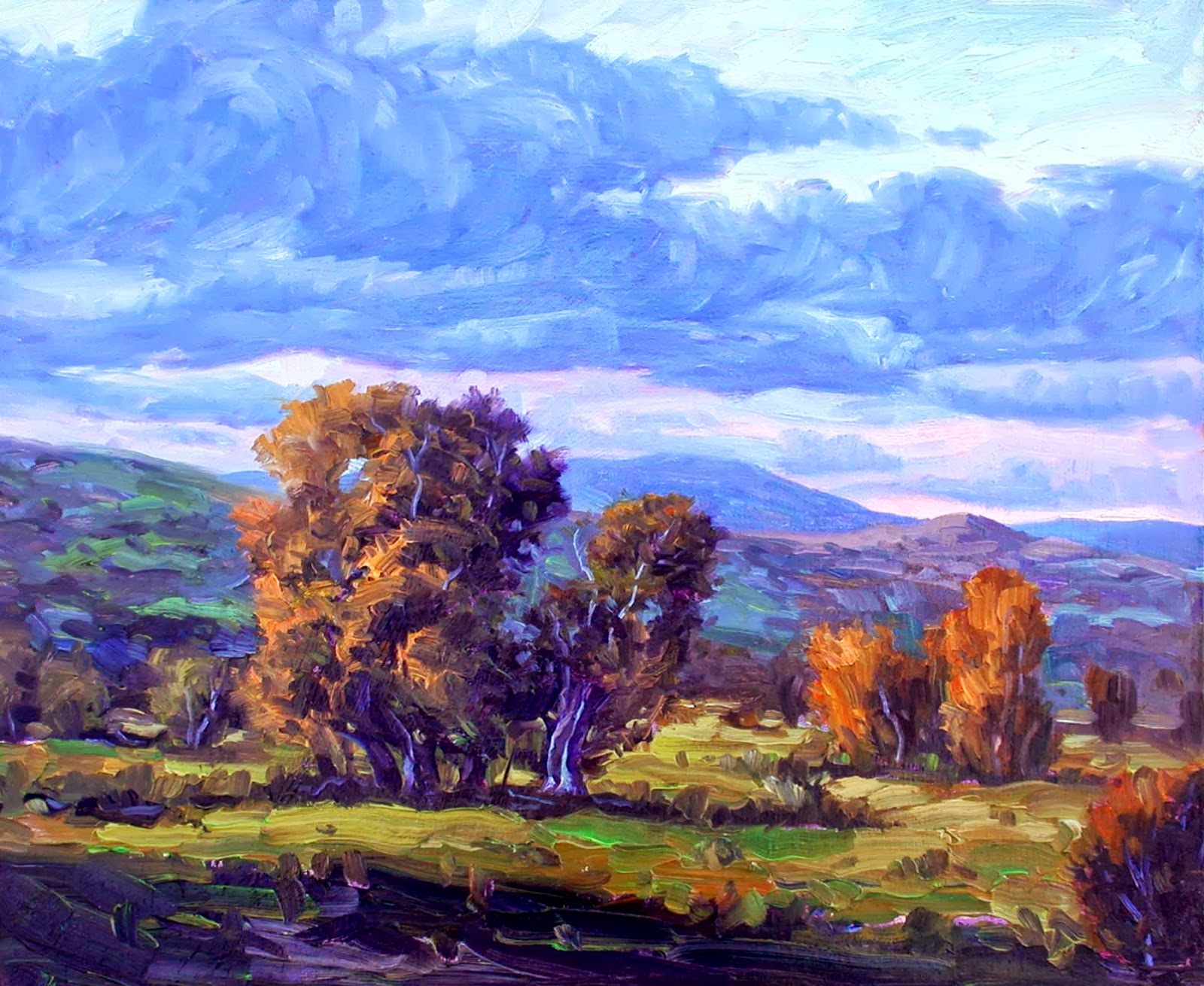 LIKE MANY artists I occasionally listen to videos as I work. Some of my habitual favorites are TED talks. TED (short for Technology, Education, and Design) provides a venue for speakers in a wide variety of disciplines. By design the messages are intellectually accessible and I usually get the point without having to review the talks. One however escaped me; J. J. Abrams’ talk entitled The Mystery Box. I was intrigued by his theme but unconvinced of his thesis. I respect Abrams for being young, ambitious, and successful in a field where being young and ambitious doesn’t guarantee success. Perhaps I needed to listen to his address one more time.
The second time I got his point. Although Abrams doesn’t address painting specifically his idea was nevertheless applicable; there must be something in art that facilitates participatory emotions. Paintings must perform some kind of magic to fully engage the viewer. Allowing mystery into the work is one way to induce that participation. Such participatory emotions neutralize self-asserting egoist tendencies. Great art dissolves personal struggle in the vastness of an all pervasive, oceanic feeling.
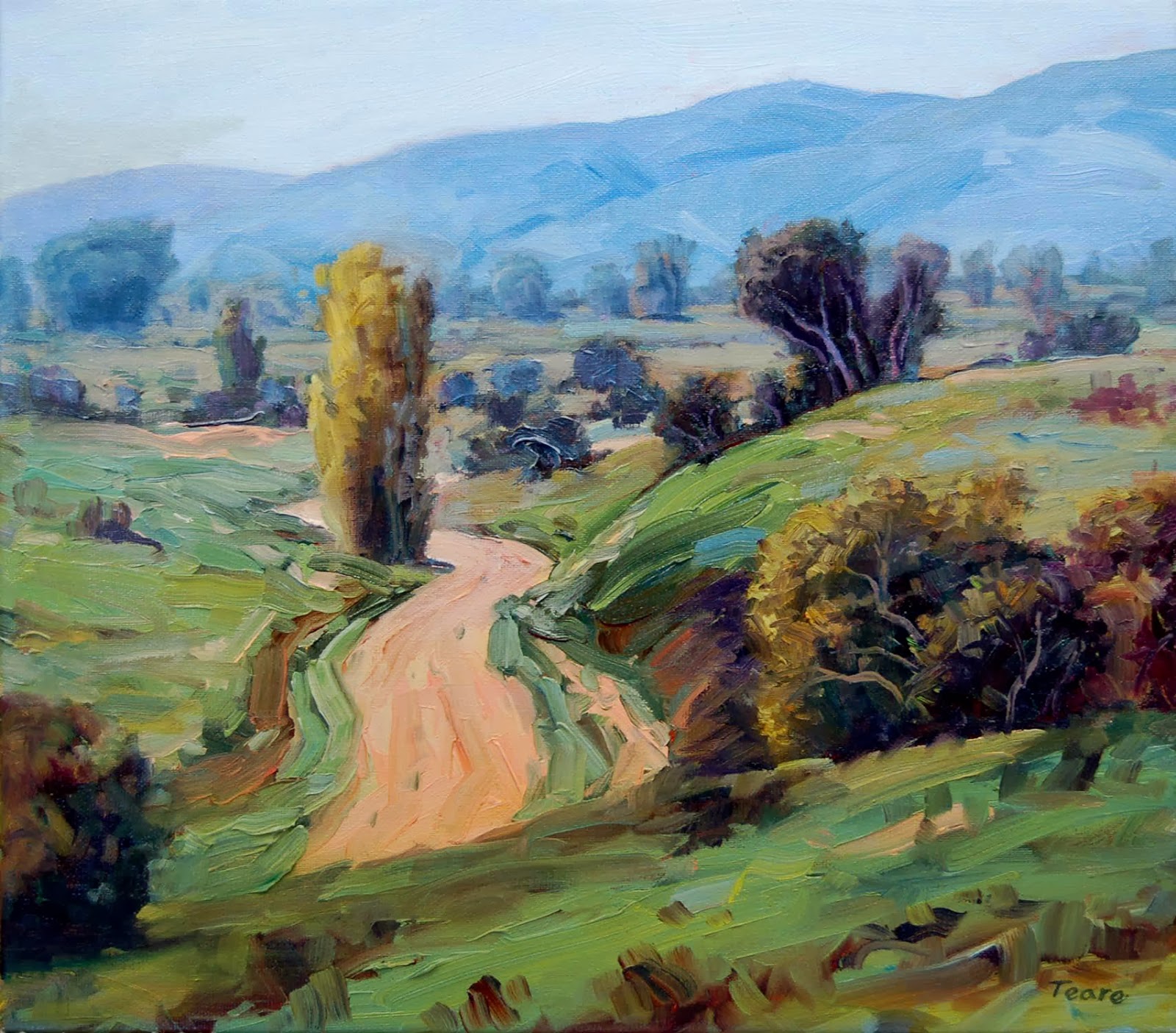
But what are we to do with this injunction to add mystery to our work? In some cases it will be a matter of doing less, allowing some ambiguity into our work like the loose brushwork of the French Impressionists. In some cases it might be as simple as depicting stories with untold endings (a path going around a corner inducing curiosity about what’s around the bend). Allowing our subconscious minds to have more sway as we create might be an answer. Ultimately it might be as simple as providing more visual questions than answers.
What is needed of art, is a simplification of life into something rich and strange.– T.S. Eliot
Brad Teare July 2013
What is needed of art, is a simplification of life into something rich and strange.– T.S. Eliot
Brad Teare July 2013
131 Exploring composition
I‘ve stated before that composition is the most important component of art. It can be simple, some of the most beautiful paintings have a simple structure, yet also complex. One of my major frustrations with the many books I’ve read on the subject is that the essence of composition is often avoided in favor of formulas that often dodge the real business of design.
No doubt I have more to learn about composition but here is a video that sums up my current thinking.
No doubt I have more to learn about composition but here is a video that sums up my current thinking.
Brad Teare August 2013
132 New online class
I recently came across a great opportunity to start an online class. It’s something I’ve wanted to do for quite some time but just didn’t know enough about the process. I decided to try Concert Window. James Gurney recently used it and reported on his blog that it was a great experience. It seems like too fun an opportunity to pass up.
The class will be on September 11th at 9:00 pm EDT. I plan on doing a one hour demo on underpainting in preparation to complete a landscape in thick paint (other classes to follow). You can buy a ticket for $1 at Concert Window. I hope you will join us!
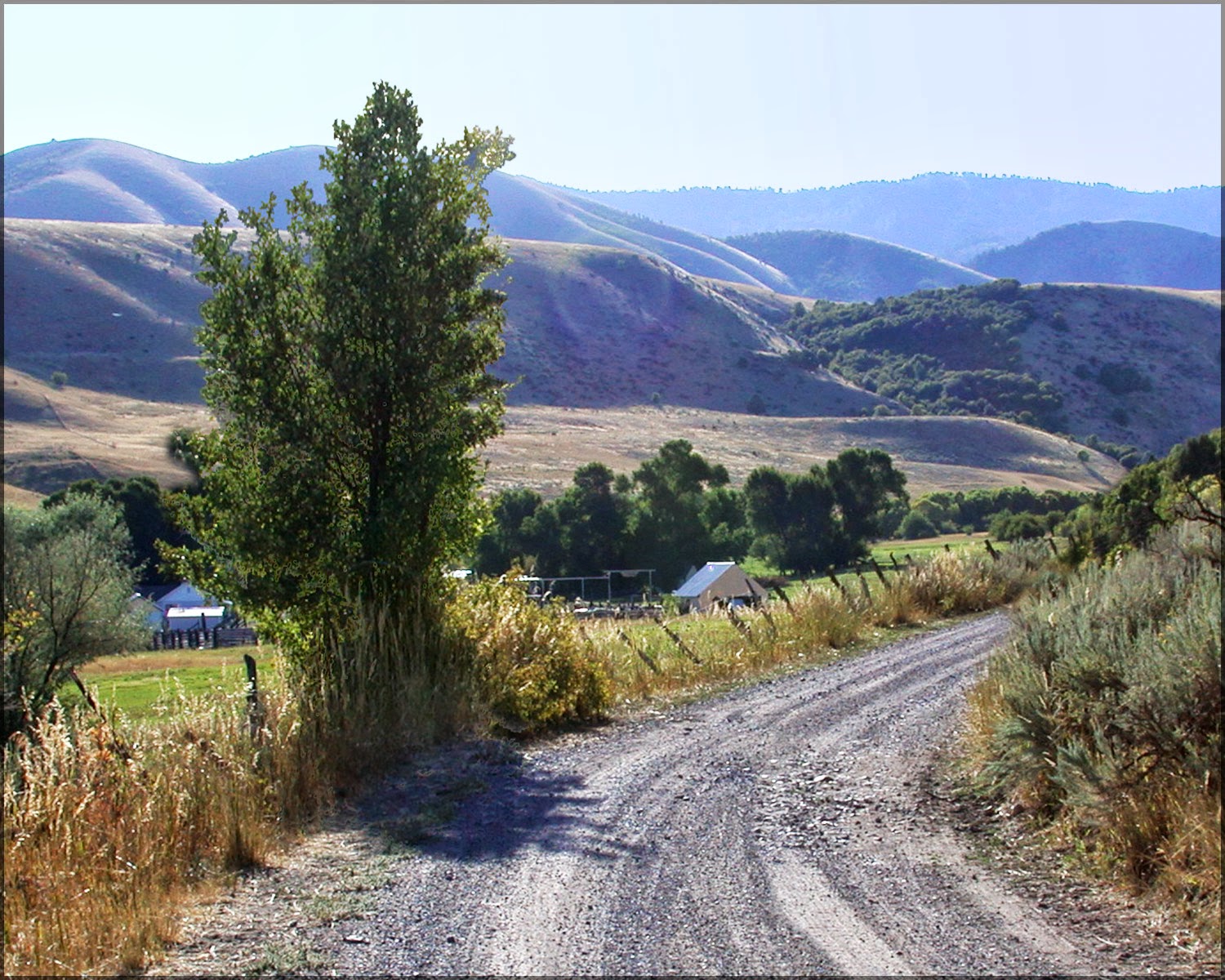
Here is the image I will be painting from. I will do a video about drawing from this sketch next Monday. If you would like to paint along with this project feel free to do a sketch based on this image or you can choose one of your own. This image is proportional to 16″ x 20″.
The class will be on September 11th at 9:00 pm EDT. I plan on doing a one hour demo on underpainting in preparation to complete a landscape in thick paint (other classes to follow). You can buy a ticket for $1 at Concert Window. I hope you will join us!
Here is the image I will be painting from. I will do a video about drawing from this sketch next Monday. If you would like to paint along with this project feel free to do a sketch based on this image or you can choose one of your own. This image is proportional to 16″ x 20″.
For more info watch the video below:
Brad Teare September 2013
133 Note to the Land Down Under
I was thrilled to get several messages from Australia saying several thick paint enthusiasts will be joining us for the live class via Concert Window. Several asked what time I would be broadcasting in Australia time. The answer is I will broadcast at 11 am Sydney Time on September 12th. In Perth it will be 9:00 am and in Adelaide it will be 10:30 am. Note that in Australia the day is the 12th not the 11th like here in the States. If some savvy Aussie would be willing to check my calculations I would much appreciate it. Hope you can all join us.
On a further note Anthony S. of Carrara, Queensland, Australia bought a 9 value grayscale. I dutifully mailed it and a month later it boomeranged back into my mailbox for a round trip of 16,000 miles. All for $1.34 postage! If you are reading this Anthony, please send me your new address. I’d love to get the grayscale to you (no charge for additional postage, of course). Or if you are a part of the Queensland art scene and you know someone who knows Anthony please let him know. Many thanks to all my friends down under!
On a further note Anthony S. of Carrara, Queensland, Australia bought a 9 value grayscale. I dutifully mailed it and a month later it boomeranged back into my mailbox for a round trip of 16,000 miles. All for $1.34 postage! If you are reading this Anthony, please send me your new address. I’d love to get the grayscale to you (no charge for additional postage, of course). Or if you are a part of the Queensland art scene and you know someone who knows Anthony please let him know. Many thanks to all my friends down under!

See you on September 11th (or 12th on the other side of the globe!)
Brad Teare August 2013
134 The Dream
 Last night I had an unusual dream. In recent years I haven’t been dreaming as much as in past eras which I attribute to not being able to sleep as profoundly. My graphic novel Cypher written in the 90s is composed almost entirely of dialog and images from dreams.
Recurring dreams are not uncommon. One of my recurring dreams is where I find myself on a tropical island. It can be evening or day, occasionally there is a thunderstorm brewing. As I walk along the beach there is a steep cliff on the right hand side. I come to an opening like the entrance to a cathedral without doors. I enter this natural fissure into a chamber hewn from rock. It reminds me what I imagine the interior rooms at Petra might look like. The ceiling is high and obscured in shadow. Descending lights illuminate the walls. On all four walls hang paintings. In previous dreams I can never quite see the content of the images, only the frames and a rough notion of color, as if I suffer from a variation of face blindness that affects perception of paintings. Although I can’t identify the blurry images I recognize the paintings as mine. There is an open door at the end of the hall with a staircase leading upward and to the left. But I never climb the stairs.
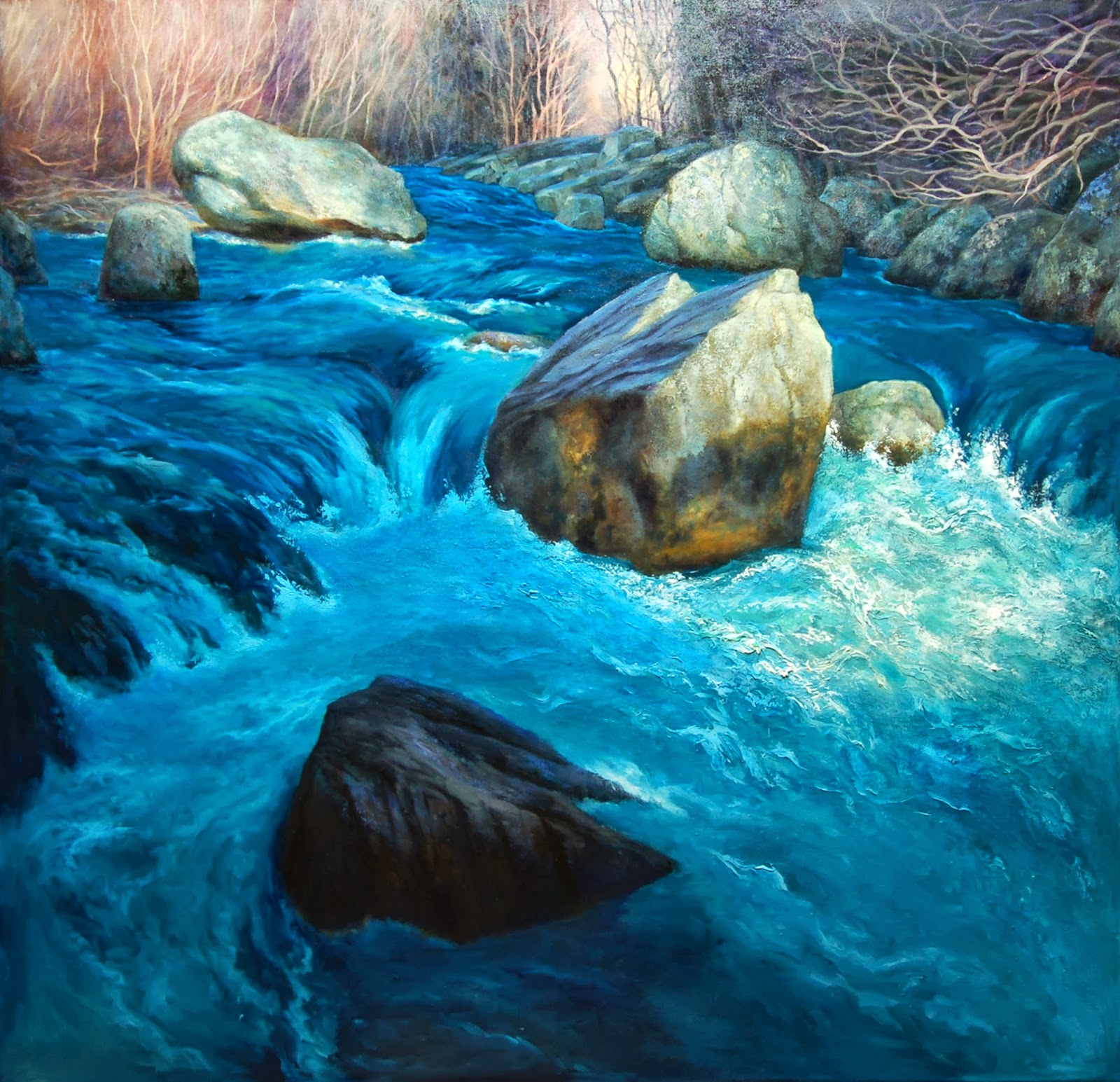
Over dozens of nights the dream is always the same with only slight variations. Until last night. Last night I walked along the beach as usual, entered the gallery, and walked through the exhibit viewing the paintings. But this time every painting was in sharp focus. They were larger than my normal paintings (30″ x 40″ or so). They tended toward a cool palette (like the recent river painting I’m working on) and had a wide range of paint strokes and marks. There were extremely thin passages with thickly textured highlights. There were passages of paint applied with the palette knife and other passages where the paint was precisely blended. They were landscapes but with a more contemporary compositional sensibility. Many were unconventional, intimate views of small slices of the landscape. Rocks were prevalent as was water, moss, and lichens. One was reminiscent of Maxfield Parrish’s’ Moonlight but with thick masses of textured paint in the highlights. These highlights were stained, glazed, and scumbled giving a rich patina to the surface.
Only two of the painting were not landscapes. One was a large mass of sunflowers in a brightly hued vase. The other showed two figures, one a male figure with a mask like the kind worn by doctors treating the plague in the middle ages. A female figure, several paces back, was dressed in medieval garb. The painting had a brooding, old-world quality like a surreal Rembrandt.
Overall, it made for a strange but illuminating night. In his book The Act of Creation Arthur Koestler explores and celebrates the intelligence of the subconscious mind. He makes a strong case for taking such experiences seriously. The annals of science and art are replete with dramatic cases of discovery and innovation via such unexpected conduits.
Brad Teare August 2013
135 Getting a professional photo
The thicker the paint the harder it is to get a good photograph in the studio,

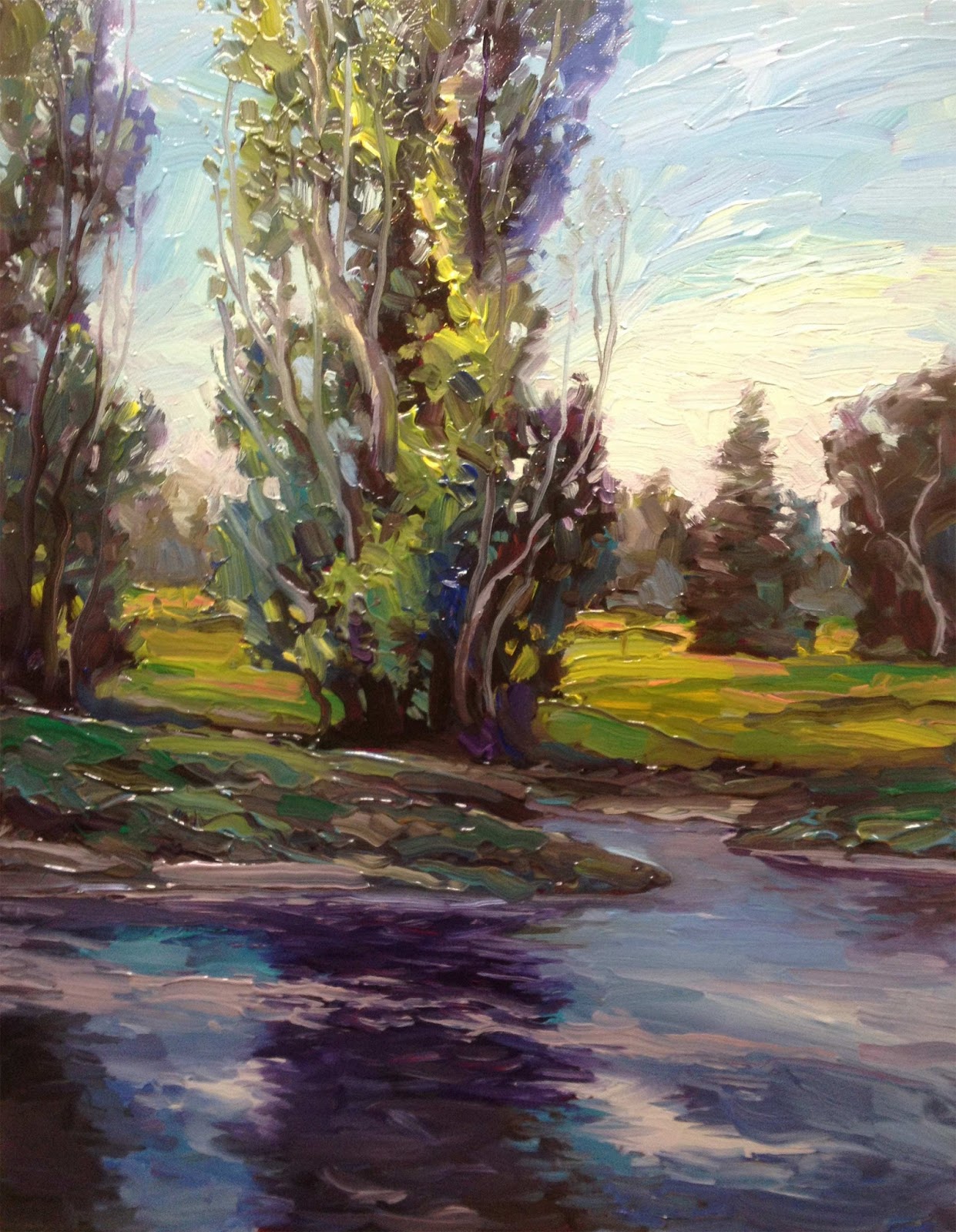
especially if the paintings are large. Shown here is a professional shot of my oil painting Between Earth and Sky, 30″ x 40″ (click image to see detail). In the new photograph you can see better hue shifts as well as more visible texture.
It is expensive to get professional photos but in some cases it is the only way to accurately communicate the depth of your work. Fellow painter Robert Britton suggested I get a light tent which I did until I realized it would take up too much of my studio.
I find that the smaller paintings are easier to photograph despite thick texture. Until I expand my studio I will use the services of a professional photographer for my large abstract paintings. Note that 90% of the photos in my book (see below) I shot in my studio with conventional studio lighting.
Another great tool I use to get great shots both for still photography as well as video is the StudioBoom–a boom that conveniently holds the camera in any position I need. Many have asked how I get the camera so close to the painting without interfering with the painting process and this boom is key. I will often film with the camera hanging upside down on the boom and reorient the footage in iMovie. With the StudioBoom I can easily take an oblique photo of a heavily textured painting–to avoid glare–and square up the resulting photo with the Photoshop Perspective Crop tool.

Brad Teare September 2013
136 Sketch video for Concert Window event
In preparation for the live demo that will be happening this Wednesday, September 11, at 9 PM EDT I filmed a video of me sketching the preliminary for the painting I will be starting. Wednesday night I will be painting a full color, full value underpainting live. I haven’t actually shown this aspect of my process very much in my videos so I think it will be of great interest to most thick paint enthusiasts.
I will be painting for approximately 40 minutes and interspersing the event with answers to your questions. My wife Debra Teare will be monitoring the computer as your questions come in. I think it will be really fun and I hope you will find the time to join us. Be sure to grab a ticket at Concert Window (just $1) sometime before the event (although I think you can still login after the event starts).
Brad Teare September 2013
I will be painting for approximately 40 minutes and interspersing the event with answers to your questions. My wife Debra Teare will be monitoring the computer as your questions come in. I think it will be really fun and I hope you will find the time to join us. Be sure to grab a ticket at Concert Window (just $1) sometime before the event (although I think you can still login after the event starts).
Brad Teare September 2013
137 Transferring the sketch to canvas
In preparation for our class on Wednesday I transferred the sketch to canvas in this 5 minute video. You are welcome to follow along if you want and paint this scene with me. I kept the video short but if you have any questions about any step of the process so far I hope you will join us this Wednesday at 9 pm EDT.
We are going to make ample time to answer lots of questions as I paint so I think it will be really fun.
See you on Wednesday! (Click here to pre-register for only $1).
Brad Teare September 2013
We are going to make ample time to answer lots of questions as I paint so I think it will be really fun.
See you on Wednesday! (Click here to pre-register for only $1).
Brad Teare September 2013
138 Oiling up an underpainting
In this video I oil up the canvas over a full value, full color underpainting. I did this underpainting exactly as demonstrated in my webcast a few weeks ago. I kept the paint thin and focused on hue and value. I reserve adding saturation for the final layer of paint. Focusing just on hue and value allows me to keep things simple on my palette as well as in my mind.
You’ll notice I’m not using my grayscale finder because I’ve already adjusted all the values in the underpainting. I simply match the values as I paint over the underpainting. In some cases I’m lightening some of the darks. This is because I decided I want to glaze the final stage of the painting (a good way to adjust saturation). If the darks are too dark there’s nothing to glaze. Glazing over a dark just makes it darker and you lose the color. So when you want to glaze at a later stage be sure to keep the darks lighter than you would otherwise.
Brad Teare September 2013
You’ll notice I’m not using my grayscale finder because I’ve already adjusted all the values in the underpainting. I simply match the values as I paint over the underpainting. In some cases I’m lightening some of the darks. This is because I decided I want to glaze the final stage of the painting (a good way to adjust saturation). If the darks are too dark there’s nothing to glaze. Glazing over a dark just makes it darker and you lose the color. So when you want to glaze at a later stage be sure to keep the darks lighter than you would otherwise.
Brad Teare September 2013
139 Glazing an impasto underpainting
In parts of my current painting, Rocks at Kent Falls, 6′ x 4′, I wanted to add some really rough impasto texture. I’ve been studying the techniques of Rembrandt and felt this would be a good application of his methods.
The main idea is to build up enough texture in the underpainting that the glaze will sink into the low points of the impasto. Some people see a similarity between this technique and the art of antiquing. If you’ve ever antiqued furniture you will understand what I’m talking about. In both techniques you simultaneously push pigment into the low recesses and remove pigment from the high points.
This can result in a mannered technique so you have to be careful and not overdo it. I may sand the finished surface when it dries to bring back some of the spontaneity and chaos of the surface. I definitely will be scumbling with very light grays and blues over the top of the highlights of the rocks.
Brad Teare September 2013
The main idea is to build up enough texture in the underpainting that the glaze will sink into the low points of the impasto. Some people see a similarity between this technique and the art of antiquing. If you’ve ever antiqued furniture you will understand what I’m talking about. In both techniques you simultaneously push pigment into the low recesses and remove pigment from the high points.
This can result in a mannered technique so you have to be careful and not overdo it. I may sand the finished surface when it dries to bring back some of the spontaneity and chaos of the surface. I definitely will be scumbling with very light grays and blues over the top of the highlights of the rocks.
Brad Teare September 2013
140: No one dies

During a studio open house I conversed with a surgeon and mentioned that a medical illustrator–a former surgeon–told me that creating medical illustrations took more dexterity and concentration than surgery. Having launched into the story with little hope of backpedaling I wondered how the surgeon would react to an artist comparing painting to surgery. I began to regret my bravado. I paused for a moment and added, “of course, with painting no one dies if you make a mistake.” The surgeon paused reflectively and then laughed. My potential faux pas was minimized by admitting the obvious. No one dies when a painting fails.
In the book, The Society of Timid Souls author Polly Morland explores the act of courage. She begins her book by describing a society started in the 1940s dedicated to the eradication of stage fright. Later she describes orchestral musicians and their struggle with performance anxiety. Up to 30% of musicians are afflicted with uncontrollable stage fright. Compared to other practitioners of activities like bullfighting or surfing monster waves their reaction seems excessive and out of place.
But the phenomenon of fear in the face of performance, even if not a matter of life or death, should be taken seriously. That which resides only in our minds still affects us profoundly. In his pursuit of excellence sports psychologist Christian Lattanzio evolved the following formula: performance = preparation + the state you access during the game. Likewise for artists preparation is not the only factor when we paint. Our state of mind is the other half of the equation. If we approach the easel with trepidation overwhelmed with memories of past challenges we diminish our chance of performing optimally. In this sense every painting is a record of our mental state.
Regarding lack of courage the author of The Society of Timid Souls offers many possible solutions. She recounts the examples of soldiers, relief workers, musicians, and extreme athletes who prevailed in their endeavors. Individual solutions will most likely spring from similar positive memories from our own past.
In my early years, I was a drummer in a rock band. During one of our first auditions, I began missing beats and botching critical fills. The more I panicked the worse I performed. Afterward, my band mates were deeply disappointed if not angry. Sometime after the audition, I reflected on my failure. I realized that what derailed my performance was not my preparation nor my native ability but fear. But my fear was a force that resided entirely within myself. It was under my control. This mental jujitsu of boldly labeling an interior state as pointless did its magic. I never failed an audition or performance again. I still felt anticipation as I set up my kit but my performances were free from debilitating anxiety.
I write this entry as a lecture to myself. My plein air experiences have devolved to the point where I no longer enjoy them and the results of my efforts parallel my mental state. Above is a plein air sketch (9″ x 12″) I did five years ago. My ability to perform is still there no doubt. I simply need to perform yet another act of mental jujitsu, realize painting is not a matter of life or death, and return to my former level of performance.
Brad Teare October 2013
141 Rembrandt’s secrets
 In the winter of 1977 I walked into the Orange County Museum and within a few paces came face to face with Rembrandt’s magnum opus The Raising of Lazarus. The texture and luminosity of the painting blew me away. All I could do was stand before it in total wonder. Later I realized I had a book with a reproduction of the painting but I didn’t recognize it. It apparently is very difficult to reproduce. The version here captures but a faint shadow of the power of the original.
I received a commission to do a figurative work without any provisions except that it illustrate in some way the mission of Christ. I accepted this unexpected challenge without full confidence I could do the subject justice. I have since been studying the paintings of Rembrandt and feel I can now move forward with some assurance that I can fulfill the commission in an artistic and professional manner. I have no illusions about approximating Rembrandt’s mastery. But I have made certain deductions regarding his work that will help me in my attempt which I will share in upcoming blog entries.
The book Rembrandt: the Painter at Work gave multiple insights into Rembrandt’s technique although I think the author missed the most critical aspect regarding Rembrandt’s methods. I will give a hint about the missing ingredient: chalk (no surprise for those who follow this blog). How Rembrandt mixed chalk with linseed oil is of critical importance. The accuracy of my deductions will be made apparent as the commission unfolds. Stay tuned.
Brad Teare October 2013
Image courtesy of Google Images
142 How to manage your brain
 In the book The Chaos Imperative author Ori Brafman outlines the the biological mechanics of creativity. I consider myself well versed in the literature of both creativity and self-improvement but had never read many of the examples of creativity cited in this slim volume. Some, like the role of the bubonic plague during the middle ages in preparing for new ideas, I had heard before but the author casts new light on the subject. The point being that in our lives as well as in history there are moments of chaos and tranquility. How we handle these moments effects how we grow creatively.
Moments of chaos need to be balanced by leisure for our subconscious minds to work appropriately. This idea has been explained before but never as clearly. I found the book hard to put down.
The main narrative of the book revolves around a project Brafman secures as an advisor to the US military. The book is not political and you don’t have to be pro-military to glean the insights offered. In fact the military might be the best example of the quintessential inflexible bureaucracy that many might think would be beyond the reach of creativity. The military is perhaps the ideal test of Brafman’s ideas.
In order to support Brafman’s thesis the author recounts many examples of how periods of leisure led to an amazing outpouring of creativity. Of course most of the moments of leisure, some perhaps better described as moments of surrender, were preceded by years if not decades of intense preparation. But the author makes the lesson clear; the incessant drive forward, no matter how disciplined, can defeat the creative process.
The Chaos Imperative was a good reminder of the necessity of play, leisure, the pursuit of pointless passions, and even the necessity of boredom. If you’ve been struggling forward yet bewildered by your lack of progress in your painting I highly suggest reading this thought provoking and well written book.
Brad Teare October 2013
143 Tip for using Galkyd
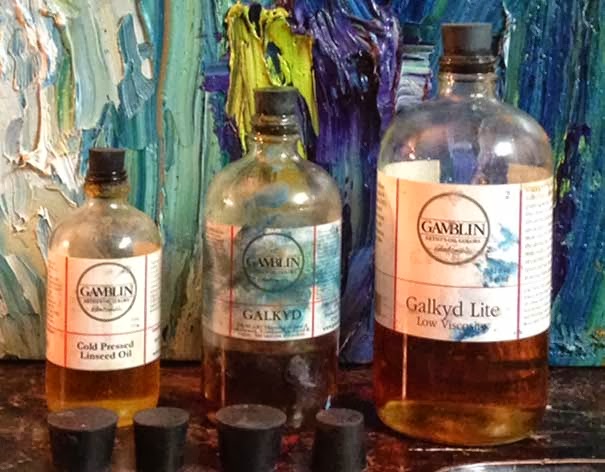 I love using the mediums made by Gamblin Colors. I use G-gel, Neo Megilp (a Maroger medium substitute), as well as all the varieties of Galkyd. The non-leveling aspect of the alkyd makes my thick paint mediums possible. However I used to throw away more medium than ended up on my paintings because inevitably the caps would crack and the plastic stoppers inside the caps failed to adequately seal the bottles. Within a short amount of time after the caps cracked the mediums would solidify in the bottles.
The best solution I’ve found is to throw the original caps away and seal the bottles with rubber stoppers of the kind used in chemical labs. I found an assortment from Amazon that sealed all the various sized bottles in my studio (with stoppers to spare). It has been over a month since I’ve been using the stoppers and none of my bottles have gone bad. I’m positive that one of my Galkyd bottles that is 3/4 empty would have been dry in the bottle by now without the stopper.
The only thing worse than buying expensive mediums is throwing out mediums that have dried in the bottles. I hope this will work for you as well as it did for me.
Please note that I have since developed a superior method of preservation using vacuum sealing. Read here. Rubber stoppers still work with larger bottles that are too big for the vacuum seal.
Brad Teare
Please note that I have since developed a superior method of preservation using vacuum sealing. Read here. Rubber stoppers still work with larger bottles that are too big for the vacuum seal.
Brad Teare
Brad Teare October 2013
144 Power of the Internet
 I‘ve mentioned the book The Art Instinct many times. I love how it describes the evolutionary expansion of technology and how the availability of knowledge increases innovation. It’s one of the reasons I created this blog.
Recently I wrote about using rubber stoppers in Gamblin mediums to decrease drying in the bottle. Several people commented and I found the information shared in the comments to be more valuable than the original information in my blog. This is an example of how ideas can be leveraged as we share ideas. It may be a simple process but anybody who’s thrown away a half used bottle of medium knows it is also an important process.
Creativity is dependent on the fusion of available ideas. The Internet is making it possible to fuse new ideas at ever increasing rates. In short, sharing ideas equals the proliferation of innovation. I find this idea extremely energizing.
With the idea of further sharing ideas via the Internet I thought it might be fun to organize a Google hangout. On Wednesday, Oct 30, 2013 at 9 pm EDT I will be going online and accepting your requests to hangout on Google. Please make your request to join my circle at least one half hour before broadcast. Also, keep in mind that Google only allows ten people per session. One option is to make the session public for others to listen to as we talk so let me know what you think of that idea.
Possible topics include using chalk in mediums, our experiences using a variety of mediums, the art of composition, or anything else really. Let me know if you have any specific topics.
For info on how to participate go here and here.
Hope to talk to you soon!
Brad Teare October 2013