IN recent entries I have mentioned using a new palette of colors to achieve more vibrant greens. In this video I expand on that idea and overpaint an old painting where the greens are quite gray.
I don’t want anyone to think I am advocating an exact formula for every lighting condition. Obviously this basic recipe will be greatly modified depending on the light. But it is a great step forward for those of us who either tend to gray greens too much or use greens with too high saturation. Additionally if you are tired of relying on tube colors the information here should prove of some value.
Ihave a large library of art books that I enjoy looking through from time to time. But what if I could only have the best five books? Which ones would they be? It didn’t take long to pick out my favorites. For one thing they are near my easel for easy reference. Although there are other books I have greatly enjoyed these are the best.
CARLSON’S GUIDE TO LANDSCAPE PAINTING by John F. Carlson Of all the books in my library this the the most essential. Although not specifically about painting with thick paint it gives all the principles necessary to paint with confidence with thick applications. This is probably the most recommended book on landscape painting. VAN GOGH BY D. M. FieldThere are lots of books about Van Gogh but most have poor reproductions. This is one of the best for the price. Van Gogh is one of the all time great painters in thick paint so you need at least one of his books in your library.
WHAT PAINTING IS by James Elkins Although this book will not suit everyone’s tastes it is one of the few books that discusses in detail the physical act of mixing and applying paint.
THE GROUP OF SEVEN by David P. Wilcox This book is replete with beautifully composed landscapes. Not all of the Seven painted thickly but there is a lot of virtuoso painting in this volume.
RUSSIAN IMPRESSIONISM by Vladimir Kruglov and Vladimir Lenyashin This beautiful book is replete with fantastic paintings few have seen. And there are lots of paintings with thick, lush strokes since many of the Russian painters of the era specialized in thick applications. I noticed that this book is currently quite expensive but check back occasionally. I have seen it used for a reasonable price. Until then you may want to substitute the book Pioneering Modern Painting: Cezanne and Pizzarro (see link below) which is a beautiful book in its own way. It contains lots of detailed close-ups and has a great deal to teach about thick paint. Brad Teare –
OCCASIONALLYI get a mental block and find it difficult to paint. Sometimes this will be caused by attempting a painting I imagine will be especially challenging, or a deadline that seems to take the fun out of painting. But whatever the cause I don’t enjoy those fallow periods especially when they stretch out too long. So what is a painter to do? One of the most useful methods is to simply make a list of each step of the painting precess. If there are challenges to the motif I can isolate my concerns. Making a list also helps simplify the process and by doing so I realize I have nothing to fear. I hope this video will help you break those aggravating, but inevitable, mental blocks.
FORGETTING to make painting fun is another way to create a mental block. This often happens when artists press too hard toward a desired goal. I once was so intent on getting a series of paintings done I began to work frantically rather than calmly toward my goal. I mistook my misguided intensity for virtue. As I became more and more frenzied the magic that lends beauty to art evaporated. Rather than relaxing and taking a deep breath I increased my frantic pace. This had an escalating negative effect. The painting entered a death spiral as I lost my original vision.
A good painting is a manifestation of the mental state you were in when you painted it. A poor painting is detached from that mental state. This detachment means there is little relationship between the artist and the final result. The painting is ambiguous, unfocused, and generic. What you intended to communicate is lost.
So how does a painter recover the state of mind that leads to good painting? You must recover the calm that promotes a direct link between intent and final result. One way to do this is to recapture the fun that originally enticed you to pursue art in the first place.
Looking at how children enjoy art we see them reveling in the joy of spontaneous creation. Their work is naïve, lacking informed decision that is the hallmark of mature creativity. They have few voices inside their heads criticizing or directing their work. But their enjoyment is pure. Back in my art school days I remember the art students that improved very quickly. Like children they drew and painted unhindered by internal criticism. They created fearlessly and without reservation. Due to their furious pace these artists quickly acquired the technical skills needed to paint well. They became the envy of the class and the focus of the teachers’ attention. However since these students lacked the internal critic most students struggled with few of these artists ultimately developed the refined sense of taste necessary to foster an individual, unique style.
Some artists with the often bedeviling internal critic slowly managed to accumulate the skills to express their artistic vision. A few surrendered to internal criticism and gave up artistic pursuits entirely.
But what would happen if an artist with a demanding internal critic (the force that develops artistic sensitivity and taste) learned to suspend the often withering voice of such a demanding master? Such suspension would allow an artist to progress quickly technically while holding the demanding critic in reserve. If one could learn to switch between the role of childlike exuberance and the role of demanding master both virtues could be fostered simultaneously.
Here is a news flash for every artist, student or otherwise: learning to paint, and refining your process, takes a lot of time and work. But if we can learn to make it fun, while retaining and fostering a critical eye, we combine the best of two worlds and our progress will be fast and rewarding. This may remain a lofty and somewhat paradoxical goal. But worth considering as we strive to develop our talents.
It has been over a year that I have experimented with putty, the little known medium for adding body to paint. I first stumbled upon putty in the entries of Rational Painting and was led to the site of Tad Spurgeon, the undisputed on-line putty expert. I highly recommend visiting his site as he has lots of recipes to experiment with. No matter what your technique most painters will find something of value. For those of us who paint with thick paint it is a treasure trove of information.
Recently I’ve been intrigued with the idea of using putty as white. Putty lends a sparkle and luster to lighter values whereas adding white paint (such as Titanium White) tends to neutralize color. Using putty as white is vastly superior to using Zinc White if you are using Zinc White as a low tinting pigment. Some studies suggest that Zinc White will cause paint to crack even if added in small amounts. Of course, putty also adds texture, a quality that is most becoming in areas saturated with light. Tad Spurgeon offers so many variations of putty I confess that I haven’t tried them all. I declined experimenting with some recipes because the effect was not what I needed but others promise to solve several problems. My favorite recipe (of my own making) is simply Gamblin’s G-Gel mixed with chalk from Amazon. I also occasionally use Natural Pigment’s Venetian medium as a couch (a layer of medium I brush onto a dry layer of paint in order to paint as if painting wet-into-wet. See entry 17).
It takes some practice to fully understand the usefulness of putty as a white additive and using putty as a couch. Initially I struggled quite a bit even though I could clearly see putty’s value in expanding the painting process beyond one session of alla prima virtuosity. Although I have yet to find the perfect putty (it would be perfectly transparent yet thicker than paint from a tube) I continue to experiment with this fascinating and useful medium.
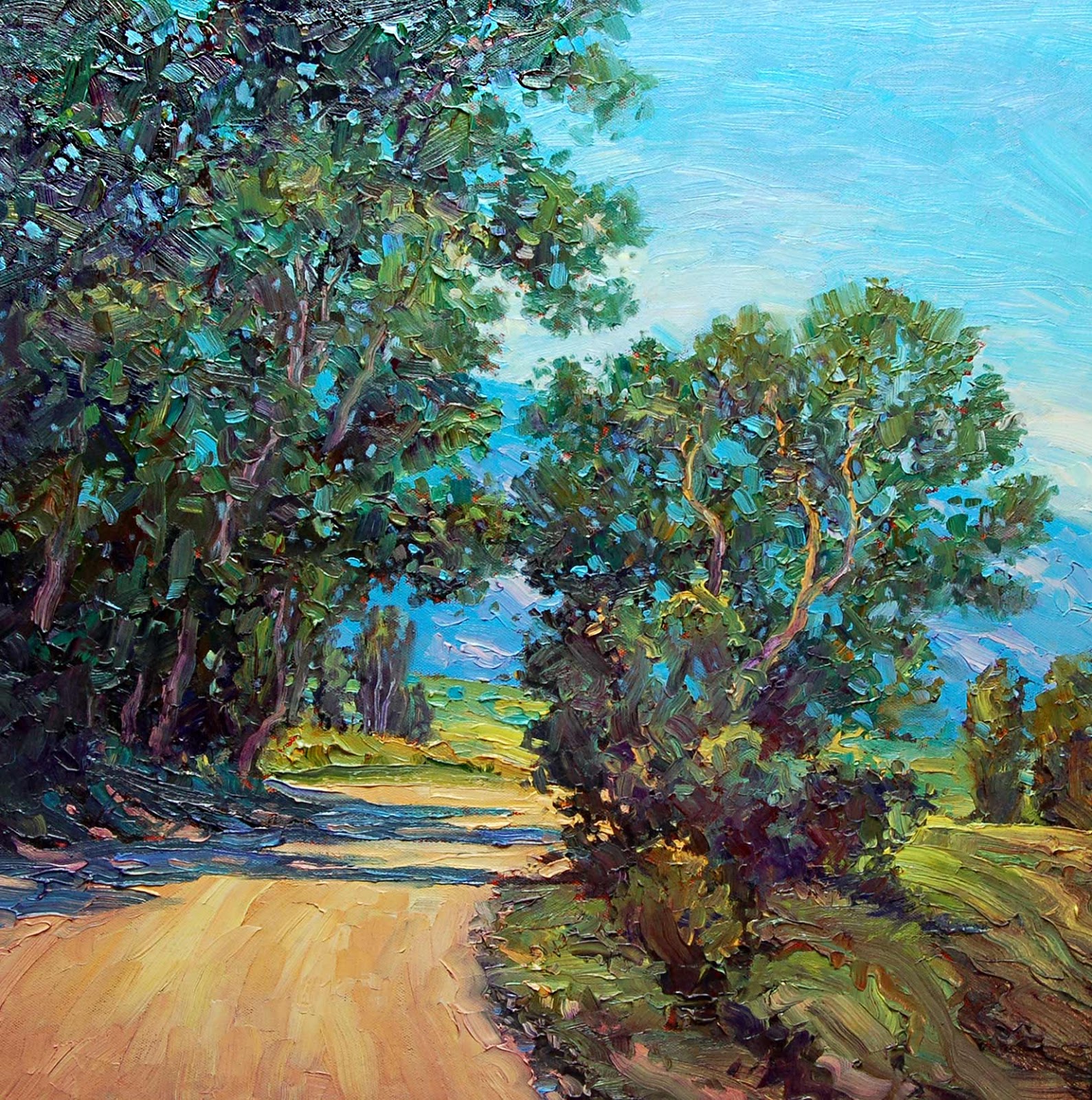
IN this video I paint a 30″ x 30″ painting alla prima, meaning I paint directly onto the canvas without going back and adding additional strokes. It is a great way to preserve maximum spontaneity in your work. I also show what happens if you use too much linseed oil in a putty mixture.
RECENTLY I purchased a set of encaustic paints. I was always somewhat intimidated by the medium, which I viewed as arcane and unnecessarily difficult, but felt there might be something to learn from the process. I purchased the necessary tools to heat and apply the colors (which are blocks of beeswax and damar crystals mixed with raw pigment). After doing a small study on a 6″ x 6″ panel I prepared a 24″ x 24″ piece of oak plywood. I lightly sanded the surface and barely stained it with a thin coat of Red Iron Oxide acrylic which I thinned to a watery consistency. I set out my colors and began painting.
The first hour was fairly frustrating as I didn’t know how to rapidly apply basic patches of flat color. But once I applied a layer of wax over the entire surface the painting began to proceed smoothly. I was fascinated to discover that after applying several coats of varying colors I could heat the surface with a heat gun and paint back into the hardened pigments. The reheated paint was surprisingly buttery, not watery nor waxy as I anticipated. The process was enjoyable although I missed certain techniques I routinely use in oil painting. However, a surprising state of mind fell over me as I continued painting in this new and challenging medium.
Since I had never studied the art of encaustic painting all I could do was follow my intuition. True, I had plenty of experience painting. A solid notion of the importance of values, hard and soft edges, and the relationship of color and composition all gave me a decent head start. But paint that liquified and dried at will was alien to my experience. As I painted a tree I didn’t think this is how Edgar Payne would paint this tree because I had never seen a tree painted in encaustic by Edgar Payne. Nor did I think Maynard Dixon would paint sagebrush like this. Because of this silent inner world that suddenly engulfed me I became keenly aware of all the voices that whisper, sometimes shout, as I practice what I previously thought to be a highly individual form of painting.
This experience showed me how I shackle my creative endeavors by allowing such voices to create a harsh and dogmatic inner world. This was particularly enlightening since I previously viewed myself as essentially immune to the intrusion of such inhibiting voices.
I suppose it is natural that a myriad of illusory voices direct our painting. Especially since we often foster an imaginary world where our favorite artists play the roles of mentors in abstencia. No doubt these self-constructed tutors help us with our artistic development. But we must be able to turn off such internal voices when they inhibit us from developing a truly individual art.
I MENTIONED to my brother Steve that my blog had been on-line for a year. He suggested posting an interview as a way of commemorating Thick Paint‘s anniversary. Since my brother and I have been bouncing ideas off each other for as long as I can remember I thought it an interesting and potentially productive idea. Here are his questions and my responses:
STEVE TEARE You have a number of Google Followers. Have you ever looked at what they do and where they live? Any stories worth telling?
BRAD TEARE I’m a very private person so I haven’t looked too deep into the backgrounds of followers and subscribers. I have been intrigued on occasion by certain photographs of art and checked out the follower’s websites. I’ve been contacted via email by a variety of artists thanking me for posting information about painting and creativity. Recently a writer in Australia wrote that the blog was helpful as she researched a book she is writing. Such emails are very rewarding.
ST There are a few permanent links on your blog. Debra Teare, James Gurney, and a few supply links. Tell us why these are on your blog? Who are these people and places?
BT Debra Teare is my wife and I find her paintings a constant source of inspiration. Her color sense is fantastic and I analyze her color schemes quite a bit. She doesn’t paint thickly, in fact she paints quite thinly, but I mention her regularly on the site and felt readers might like a convenient link to her work.
James Gurney was the first artist to showcase Thick Paint on his blog Gurney Journey. Immediately after he linked to my site I had hundreds of hits per hour. That dropped off considerably over the next few weeks but it was enough exposure to give my site a really great launch. In addition to my appreciation for James Gurney’s generosity Gurney Journey is a great blog that should be on every artist’s favorite blog list.
The Rational Painting site and Tad Spurgeon’s website really helped me get a handle on how academic techniques could relate to impressionist painting, which is something I don’t think has been fully explored. A lot of my techniques relate directly to what they are doing and they are both fantastic resources.
ST If I google the search phrase Brad Teare, I find you’re more than just Mister Thick-Paint. You’ve experimented in lots of other areas. Like book covers, children’s books, comic art, graphic novels, woodcuts, museum exhibits, private art collections, and others. Most of your blog readers don’t know these different aspects. Do you think it would upset them to know you’re so diverse? They normally only see a serious slice of your interests.
BT We live in an age dominated by specialists. I do think it might be confusing to some that I have roots in so many diverse fields. But since I obviously didn’t edit out this question maybe I’m finally ready to own up to my past. A lot of what I did in the past doesn’t seem that relevant. For example, I never thought my work in animation had much relevance except as a great preparation for my illustration career. But now that you pose the question it might be useful, especially for younger artists, to reflect on how artists evolve and progress. It is particularly important for young artists to understand that meaningful art is mostly a product of hard work and not necessarily of genius. I’ve been very conscious of young artists as I’ve created this blog so maybe it’s time to acknowledge my roots. I will definitely reflect on this theme (maybe it will appear in a future blog).
ST You rely on video quite a bit to communicate on your blog. Do your blog visitors enjoy these most? Or do you think there’s a fair number who get into the read, too?
BT There’s no doubt that my videos draw the most attention. I think a lot of people have discovered my blog via YouTube and I suspect a lot of YouTube subscribers don’t bother with the essays. But I hope that the two mediums complement each other. I try to edit out any redundancy. A lot of people do creative work on the computer and they’re able to listen to videos while they work so the videos have that advantage. There’s no doubt that a part of the genius of YouTube is its incredible search engine. I can monitor how viewers discover my site and the accuracy of the search engine is amazing. I take my hat off to YouTube.
ST You’ve been blogging for over a year with Thick Paint. You’ve had success where others have failed. Why do you think your blog traffic is good?
BT I really have no idea how my site compares to other sites. And, of course, success is relative. But much to my surprise the site has attracted nearly 100,000 visitors. That is far more than I ever imagined. I attribute the high traffic mostly to the YouTube portal. Other than that I think people respond to my practical, straightforward approach, an approach that might be hard to find in some art schools.
ST What do you feel are some of the rewards of producing the Thick Paint blog? And how about the downside? Any negatives?
BT The biggest reward for me has been how filming and writing about painting has clarified my thinking. I now know what I want to do with my painting, or a least much more so than a year ago. It’s difficult to describe how writing about process clarifies your thinking but it definitely has happened. What remains for me now is to harness that insight and create a body of work that reflects that clarity. As far as negatives go, I can’t really think of any except that occasionally the filming process for some reason inhibits my concentration. It doesn’t happen often and if it does I just stop filming. Most of the time the filming just gets intertwined in the creative process. Sometimes the editing process gets too lengthy. But lately I’ve been trying to film so I have less editing to do.
ST Have you had any surprises or serendipity with Thick Paint?
BT I am fairly confident I was invited to the Door County Art Festival due to my blog. And due to my participation in Door County I was invited to exhibit at the Marshall LaKae Gallery in Scottsdale, Arizona. That was a convoluted and extremely satisfying series of serendipity for which I’m grateful. My detour into encaustics has been a huge surprise and only possible due to previous discoveries, many of which occurred on the videos.
ST Has reader response been helpful in the creation of new blog ideas?
BT Yes, readers have often prompted follow-up essays and videos. I appreciate both the gratitude readers express as well as their questions, comments, and suggestions. I’ve had readers recommend books that proved quite interesting as well as offering variations on technique. Recently I read an intriguing book entitled The Rational Optimist that basically related how all advances are due to a cross-pollination of ideas. I hoped that Thick Paint could be such a vehicle, although I’m certainly striving to magnify that role.
ST If Thick Paint had a manifesto, what would it say?
BT The manifesto might be The history of painting begins now. Back in the 90s there were scores of essays with titles like The End of Art, The End of Painting, The End of Beauty, or other such nonsense. I had a college professor who basically said to me everything in impressionist painting had been discovered 100 years ago. That just didn’t ring true. In fact it sounded a lot like scientists in the past who claimed that every innovation had already been discovered. There is something shockingly small-minded about such a declaration. Yet I also knew that the great majority of painters were churning out images far too similar to what we’d seen in the past. But I know that innovation is still possible. I’m not claiming that my work is outrageously innovative. But Thick Paint is a small attempt to be a part of what I suspect will be the beginning of a very innovative era. There’s no better way to share information than the Internet and I think it will revolutionize painting as ideas increasingly cross-pollinate.
ST You created a lot of blog content in December 2009 right after you started Thick Paint. Where did you find all the energy?
BT I did create a lot of content initially and am not sure how I did it except to say I seemed to be on automatic pilot. I’m really a very introverted person. So for me to essentially invite dozens of people into my studio was pretty nerve shattering. Had I known it would be thousands of people watching the videos I’m not sure it would have made any difference. Once I got the idea I just had to do it. I had to see where it would lead. As you’ve noticed the frequency of videos and essays has diminished quite a bit so the initial burst of energy has tapered off. But I still have a list of great topics I hope to write about and film so I hope in time they’ll make it onto the blog.
AFTER dabbling in encaustics I’ve been intrigued with wax lately and decided to try adding it to a couch on an oil painting. I applied the wax medium to a failed painting and was able to add quite of bit of texture, which I adjusted so the values created a more pleasing design. I was surprised at how buttery the wax medium was, and how it really grabbed my paint off the brush. I’m very intrigued with wax as a medium and will be trying adding cold wax medium to my paints as well.
THIS video completes my experiment oiling up the canvas with a cold wax and oil medium. Specifically I used Gamblin’s Cold wax and their appealingly thick G-Gel. There are few surprises here, I basically just complete the painting using ideas started in part one. But it was satisfying to note that the medium maintained its thickness despite wiping off, adding pure paint, and generally pushing paint all over the surface.
THE PLEIN AIR movement has been good for painters and landscape painting. It sparked a renaissance in the art of observation and a return to artistic fundamentals. It helped refocus landscape painter’s attention back to the source of its inspiration. I have benefited artistically by painting in the field and financially from invitations to various art festivals. I commend these festivals for substantially enlarging the number of landscape collectors in America. I plan to continue painting en plein air as well as attending plein air festivals.
However an unintended consequence of the resurgence of plein air painting has been an emphasis, perhaps an overemphasis, on painting as a virtuoso performance for the benefit of spectators. At such events the most prized paintings are often the paintings done the quickest. I don’t criticize these events. They’re a lot of fun. But the trick is to compartmentalize this mental state and relegate it to the proper moment. And the proper moment for a virtuoso performance is not when you’re in the studio struggling to express your inner vision.
Recently I’ve noticed that the mental state I have while performing at plein air events has invaded my studio painting. While painting in the studio I not only habitually intend that each painting be a virtuoso performance, but often that each brush stroke be one as well. The pressure became so great I needed an escape. So I have switched, perhaps for just a season, to a completely different medium. The medium I chanced on is encaustic. There is a roughhewn quality with encaustic reminiscent of the art of woodcut, accompanied by the mental state I associate with sculpting. Encaustic is a medium that can’t be hurried. It is also a medium that doesn’t need to hurry. The drying time is indefinite and I can reactivate the painting surface simply by reheating it.
I will explore this medium for as long as it takes to unshackle myself from the burden of virtuosity. I intend to immerse myself in the encaustic process until painting becomes a kind of meditation and I relearn the art of painting slowly.
AFTERHigh School my friend Joe Hebert and I left our Kansas home and traveled to the foothills of Moscow Mountain–in Northern Idaho–where we built a log cabin. A nearby farmer let us salvage lumber from an abandoned barn which we used to build the floor, roof, as well as the door and furniture. It was an interesting project and allowed me to live frugally so I could pursue art full-time.
Toward the end of my one year stay in the cabin I enrolled at the University of Idaho and began my formal study of art. I took drawing classes and started learning the rudiments of oil painting.
An early influence was the work of Rockwell Kent whose work I discovered in the local library. I was fascinated by what I assumed was woodcut, although Kent worked primarily in pen and ink making the occasional wood engraving. But his strong composition and stark contrast deeply impressed me. Above all I was fascinated by Kent’s adventurous life. Later I would purchase a printing press and begin my own adventure illustrating in New York City.
The artist’s life seemed infused with vibrant potential. I look back with nostalgia on that era. There were many things I didn’t know about an art career, that there are many factors outside an artist’s control, that the economy can create seemingly insurmountable obstacles, that the tastes and fashions of the art world can present frustrating challenges.
Strangely, it was a recent trip over the Sierra Nevadas to San Francisco and down the San Joaquin Valley that sparked my introspection and rumination on my artistic roots. As I passed through a region of lush green foothills sprinkled with majestic outcroppings of rock I remembered an earlier phase where I painted large acrylic paintings on stretched watercolor paper mounted on plywood. My favorite motifs were rocks covered with moss and lichens.
I recalled other periods where I sculpted, painted in watercolor, created science-fiction book covers, illustrated children’s books, wrote and drew alternative comic books, animated television shows, and of course, painted landscapes with strokes of thick oil paint.
I undertook all these projects with a sense of adventure. That sense of adventure is perhaps what I like most about the artistic life. Through it all my most persistent ambition has been to paint the landscape. Yet currently I find very little air beneath my wings. So for the next year I have decided to set aside oil painting and begin a new project. This project will be of a more commercial nature but ultimately designed to reinvigorate my painting career. If all goes well I will return to the Thick Paint blog revitalized and ready to create new videos and blog entries chronicling larger, more energetic paintings. Although I will not be making new blog entries or videos for a year I will monitor comments and continue to answer questions.
I look forward to sharing what I learn in the coming year. I hope you will rejoin me in March 2012. PS- March has come and gone and I still haven’t finished my commercial project. The best estimate now is a June 1, 2013 for a return to painting. Wish me luck!
AS I MENTIONED in my last blog I will be taking a break until March 2012. This will give me time to recharge the batteries as I work on a more commercial project. I also need a new hat and am willing to trade a painting for information on where to order one (see video). So next time I film I hope to be wearing a new chapeau (my old one clearly needs to be replaced!). I hope you have a great year painting and hope to hear from you again in March 2012. Many thanks!
I’m making an exception to my No Blogging Until March 2012 rule because a friend sent me this great web site. I found Austin Kleon’s ideas both inspirational and practical. The only thing I didn’t absolutely love about the essay–and this is very minor–was the idea that there are no new ideas. I only emphasize this small difference of opinion because I think it is important to believe in radical innovation, those quantum leaps that change everything.
I know it is a really small thing but my method of scraping the palette with the left hand and swiping paint off onto the canvas with the right is a new idea (albeit it a small idea). As far as I know that specific idea has no pedigree. It is dissimilar from any painting method I know (although I freely admit that someone else may have stumbled on this interesting but simple way to paint). We all make our contribution and small innovations can add up to large changes.
Not everything has been discovered relating to landscape painting. The genre is alive and well and poised for change by a series of innovations. Such discoveries will not be made by those who view painting as a series of recipes but by those who believe innovation is possible.
In short, I think it is best to borrow freely but be open and hope for true, unfettered innovation. Maybe these small innovations are like mutations (an idea I borrowed from this book). Innovations seem to come out of nowhere, but when they prove useful and are fused with other ideas they begin their metamorphosis as others borrow them and make them their own. One thing is certain; the rate of innovation increases as we share our discoveries with each other.
I admit that bolts of lightening from the sky are few and far between. But when they strike no other experience compares.
Many people have asked me how I make my Thick Paint videos so I decided to do a short entry on the process. There isn’t too much mystery although some have inquired how I film as I paint. I hope you enjoy this and I’ll see you again March 2012.
Here are links to the items mentioned in the video. Note that I am using a Mac with OS 10.5.8:
IN THE PAST YEAR digital publishing has evolved considerably. A digital book about thick paint could be extremely interesting. Imagine these blog entries placed in logical order, with new chapters and videos bridging the gaps, and published as a digital book. A book made with iBook Author would have text, video, and high resolution images that could be enlarged to see extreme close-ups of the textures of each painting. It is an ideal format for painting instruction and I am very enthused to complete such a project.
I’m considering Apple’s iBook Author for its low creation costs and universal availablility via iTunes.
I really appreciate all the encouragement and kind words I’ve received since the inception of this blog. I couldn’t do it without your support. Thanks so much.



 that basically related how all advances are due to a cross-pollination of ideas. I hoped that Thick Paint could be such a vehicle, although I’m certainly striving to magnify that role.


 (an idea I borrowed from
  .
. (I notice they have a 14 mega pixel version available now.)
 (this link is to the Mac version.)
